LLM-Guided Common-Sense Planning for Long-Horizon Underspecified Tasks
Working paper · In progress · October 2026 In progress
Abstract
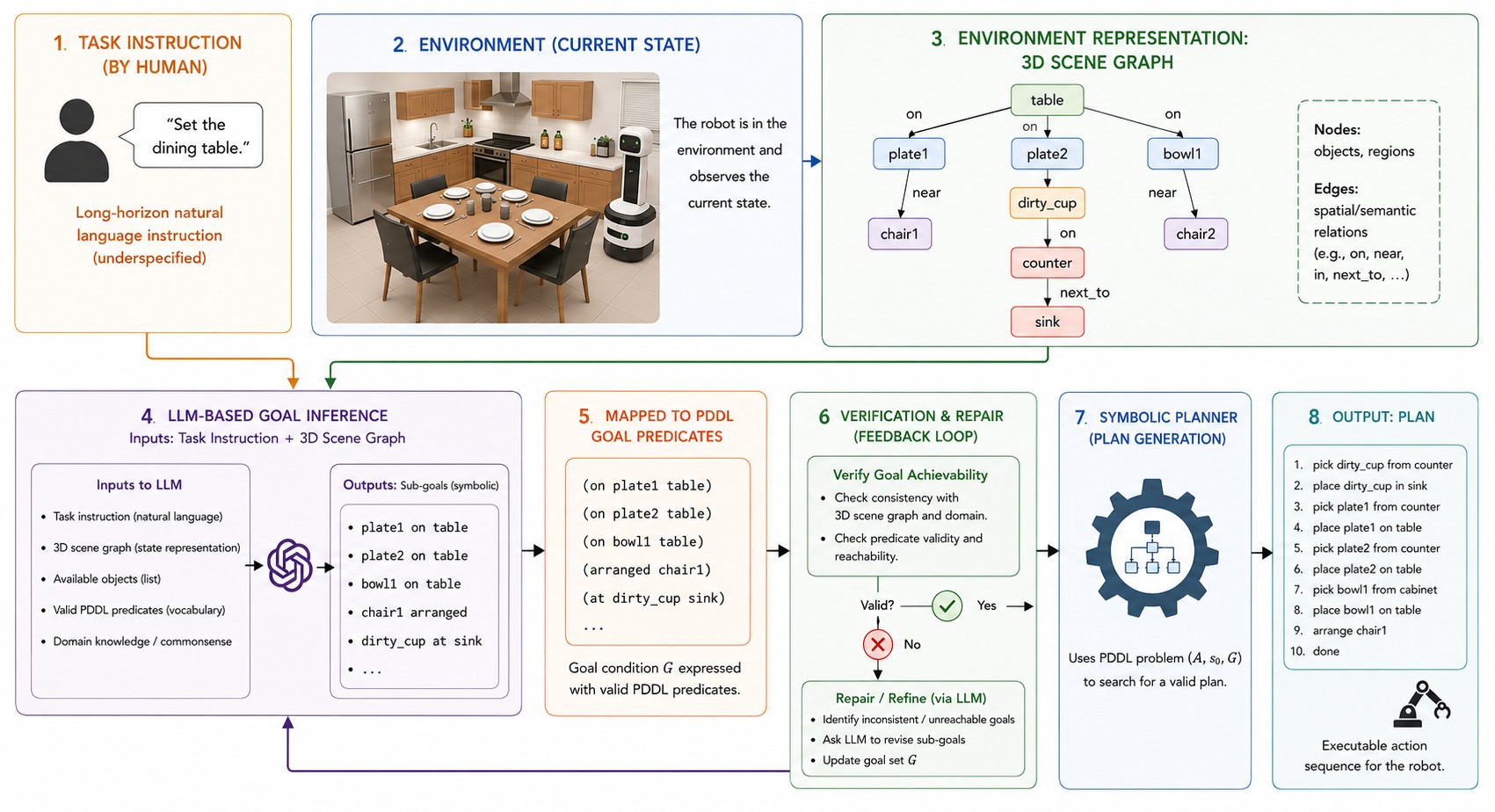
Robots are increasingly expected to perform long-horizon tasks from high-level instructions such as “set a dining table” or “make dinner.” Such instructions are often underspecified: they name a desired activity without stating the goal state required to complete it, leaving the robot to infer intermediate objectives that humans supply effortlessly through common sense. This common-sense gap is a core obstacle to humanlike behavior in humanoid robots operating in everyday human environments. Classical planners require an explicitly defined goal and cannot operate directly from such instructions, whereas large language models (LLM)s possess broad common-sense knowledge but offer no guarantees on plan correctness or executability. We propose a hybrid framework that assigns each component the role it is suited for: given the current environment state (represented as a scene graph) and a high-level task description, an LLM infers a set of grounded symbolic subgoals, which are then verified against the planning domain and solved by an off-the-shelf symbolic planner. We hypothesize that decoupling goal inference from plan generation lets a robot complete a broader class of long-horizon tasks while retaining the reliability of planning-based execution for the steps it produces. We will evaluate the approach in a simulated kitchen–dining domain using task-completion rate, planning cost, planning time, and agreement between inferred and ground-truth goals, and we plan a real-world demonstration that mirrors the simulated domain.
Citation
R. Dhakal, "LLM-Guided Common-Sense Planning for Long-Horizon Underspecified
Tasks," working paper, in progress, October 2026.