Roshan Dhakal
Working paper · October 2026 In progress
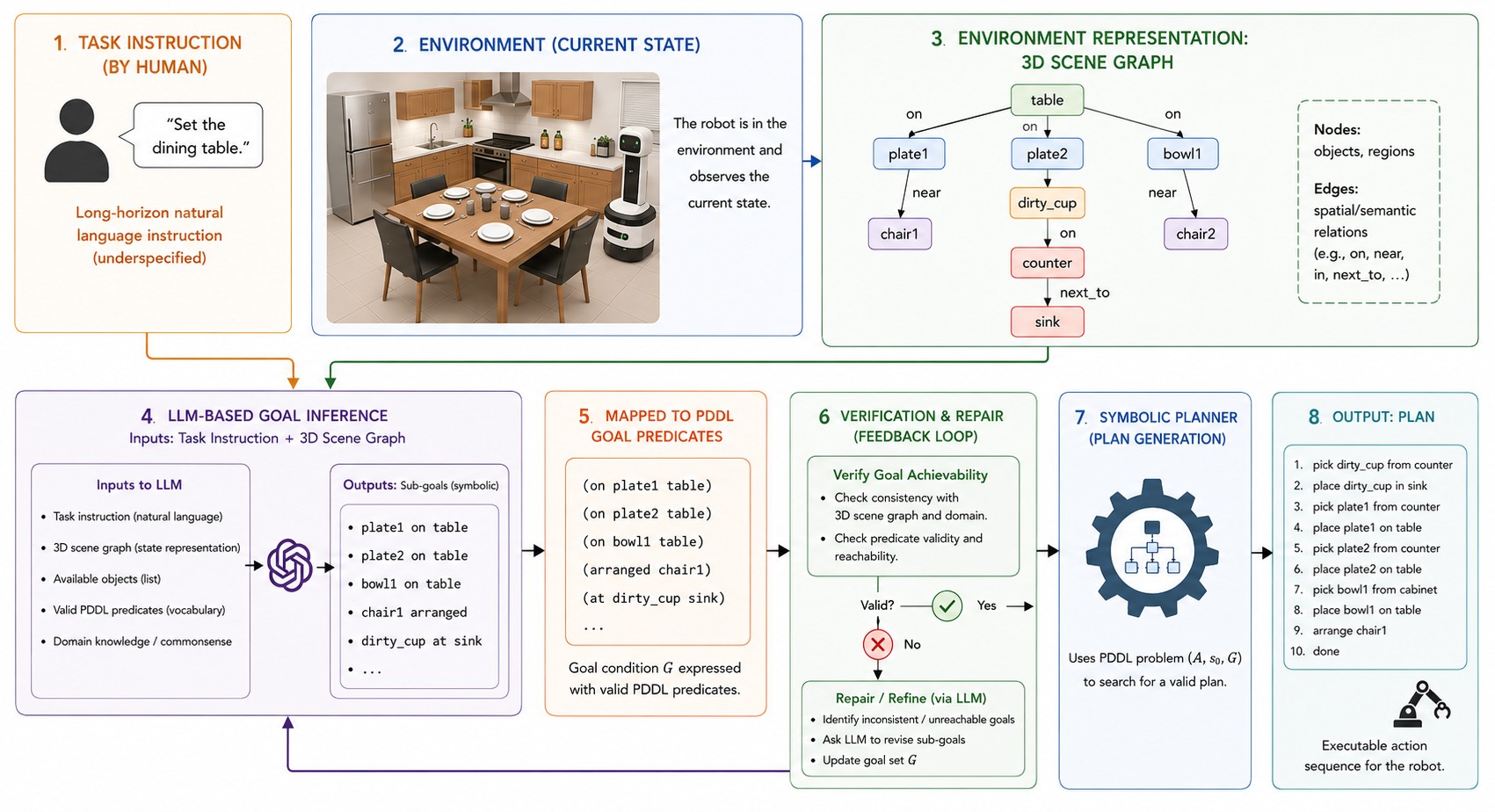
Instructions like “set the dining table” name an activity but never state the goal. An
LLM infers grounded PDDL goal predicates from a 3D scene graph, the predicates are verified against
the planning domain and repaired through a feedback loop, and a symbolic planner produces the plan.
The LLM supplies the common sense; the planner keeps the plan correct.
Roshan Dhakal, Abhishek Paudel, Gregory J. Stein
IROS 2026 Workshop on Search Algorithms for Robot Learning · Pittsburgh, PA · September 27, 2026
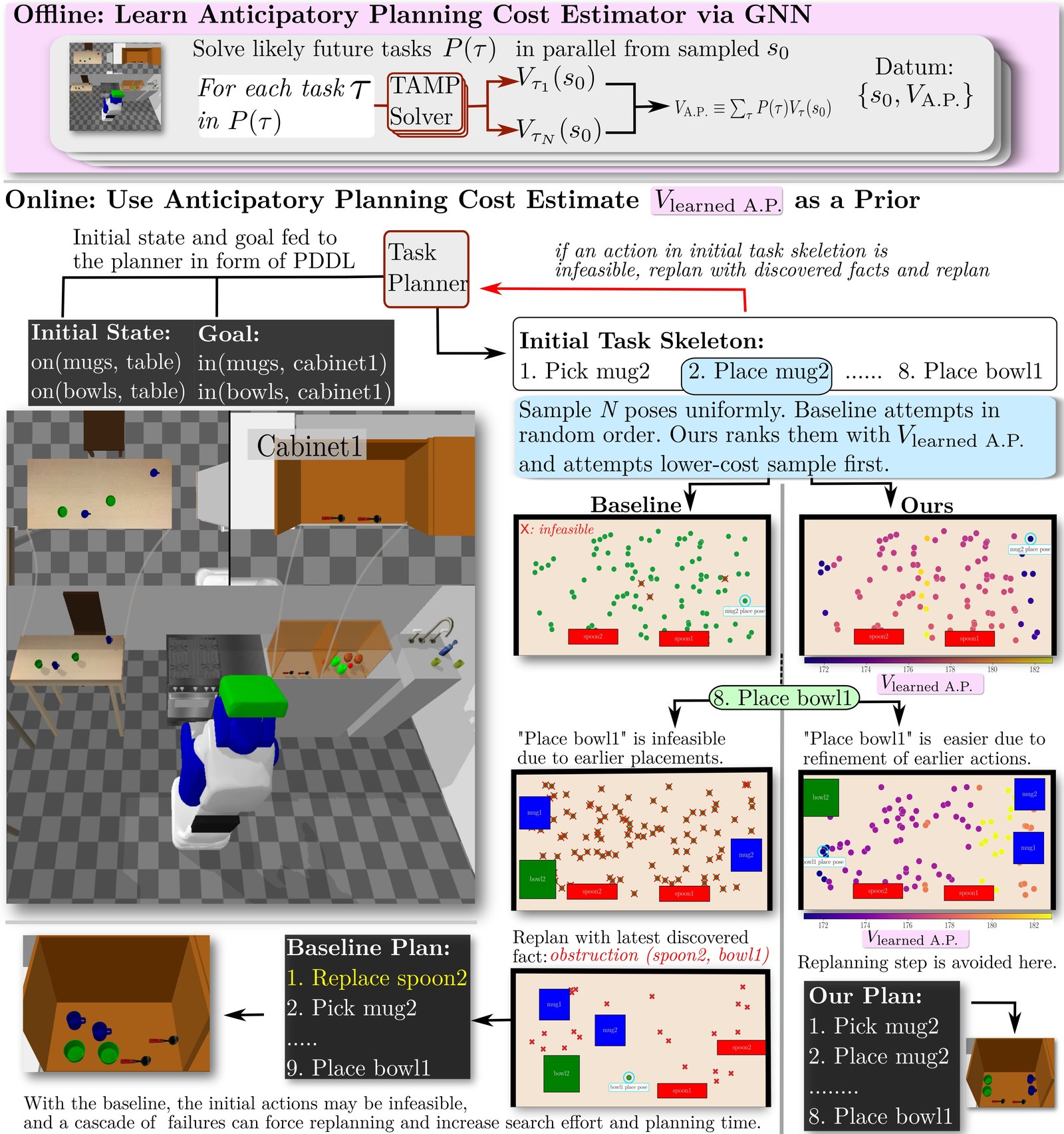
A sample that is feasible right now can still leave the scene in a state that makes later actions
of the same plan harder to refine, triggering failures and replanning. We rank sampled candidates
by a learned anticipatory cost and attempt them in increasing order, leaving the sampler,
feasibility checks and objective untouched. At a matched sampling budget this cuts planning time by
up to 34% and search evaluations by up to 53%.
Roshan Dhakal, Duc M. Nguyen, Tom Silver, Xuesu Xiao, Gregory J. Stein
IEEE Robotics and Automation Letters (RA-L) · 2025
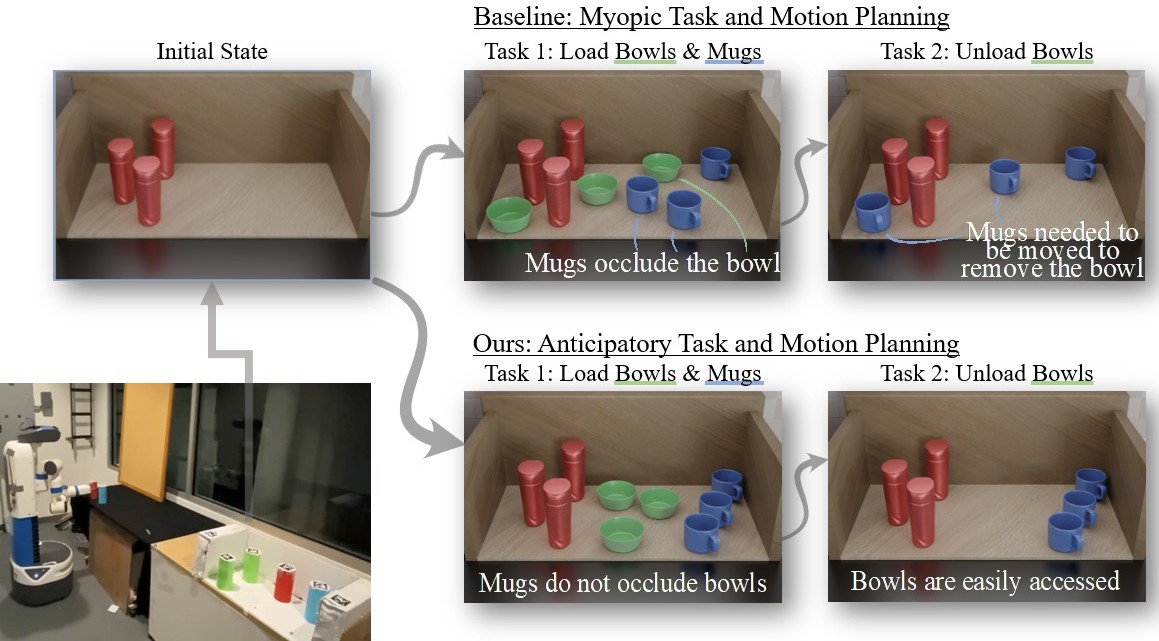
We present a learning-augmented task and motion planning framework that anticipates the future
impact of current actions and selects plans that reduce long-term cost across sequences of
rearrangement tasks in persistent continuous-space environments.
Roshan Dhakal, Md Ridwan Hossain Talukder, Gregory J. Stein
IEEE International Conference on Robotics and Automation (ICRA) · 2023
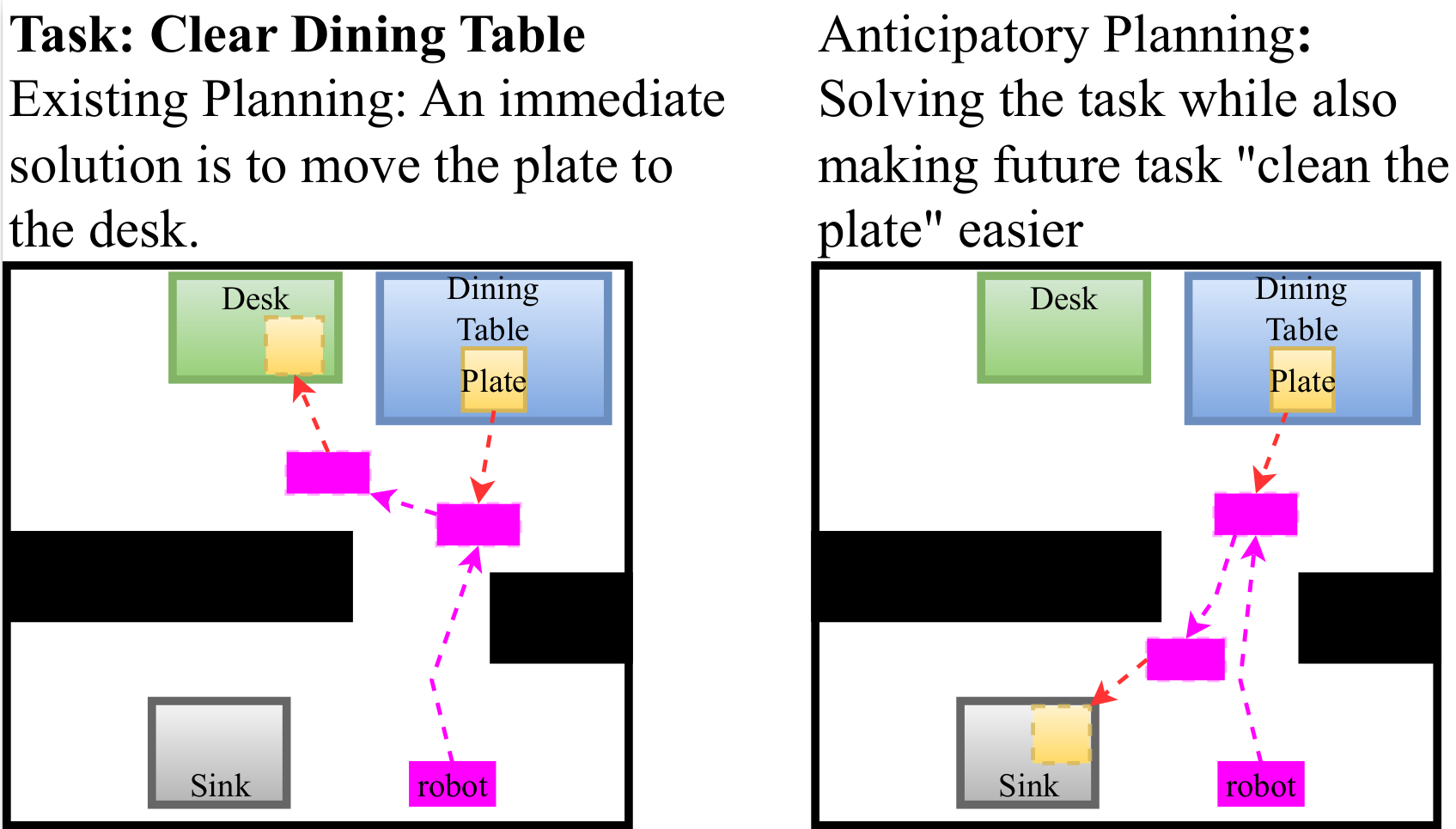
We introduce anticipatory task planning, a formulation that helps robots solve current tasks
while reasoning about the expected cost of unseen future tasks.
Abhishek Paudel, Roshan Dhakal, Sakshat Bhattari
arXiv preprint · 2021
We model floor plans as graphs and use graph neural networks to improve room classification
performance by leveraging relational structure in building layouts.