Anticipation as a Prior for Efficient Sampling in Task and Motion Planning
IROS 2026 Workshop on Search Algorithms for Robot Learning · Pittsburgh, PA, USA · September 27, 2026
Abstract
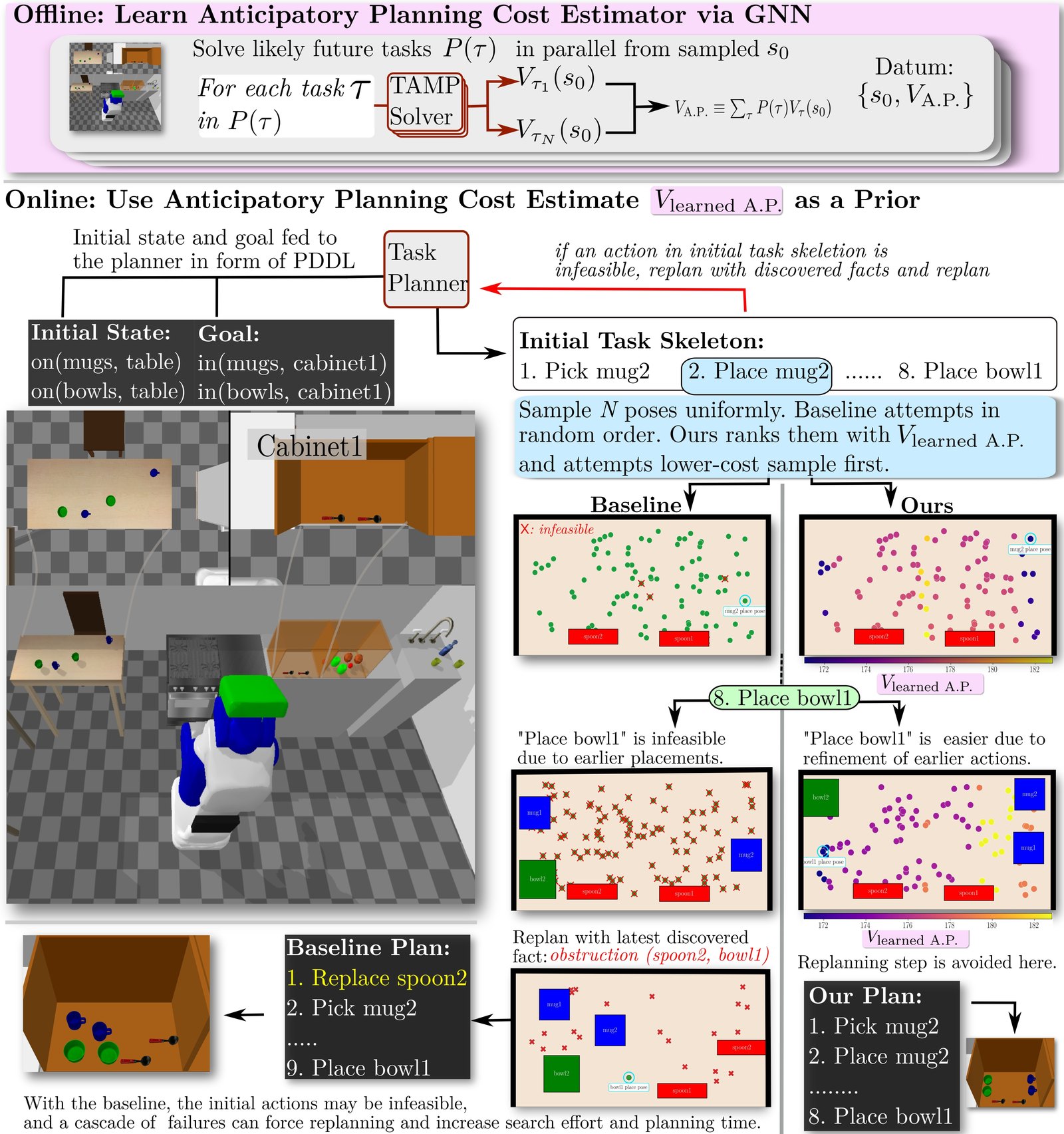
A task and motion planning (TAMP) solver spends much of its computation sampling continuous parameters, such as placements, with little information about which samples are worth attempting. A sample that is feasible for the current action can still leave the scene in a state that makes later actions of the same plan harder to refine, triggering failures, replanning, and additional search. We show that anticipatory planning cost—a learned estimate of the expected cost of future tasks from a state, originally introduced to learn the impact of an action on future tasks that are not yet assigned—can be used as a computational prior that biases sampling inside an off-the-shelf TAMP solver. Sampled candidates are ranked by their anticipatory cost and attempted in increasing order, leaving the planner’s sampler, feasibility checks, and objective unchanged. Across 256 trials in a simulated kitchen, at a matched sampling budget, the prior reduces planning time by up to 34% and search evaluations by up to 53% relative to the same solver with uniform sampling.
Citation
R. Dhakal, A. Paudel, and G. J. Stein, "Anticipation as a Prior for Efficient
Sampling in Task and Motion Planning," in IROS 2026 Workshop on Search
Algorithms for Robot Learning, Pittsburgh, PA, USA, September 2026.