LLMs · Scene graphs · PDDL · Fast Downward In progress
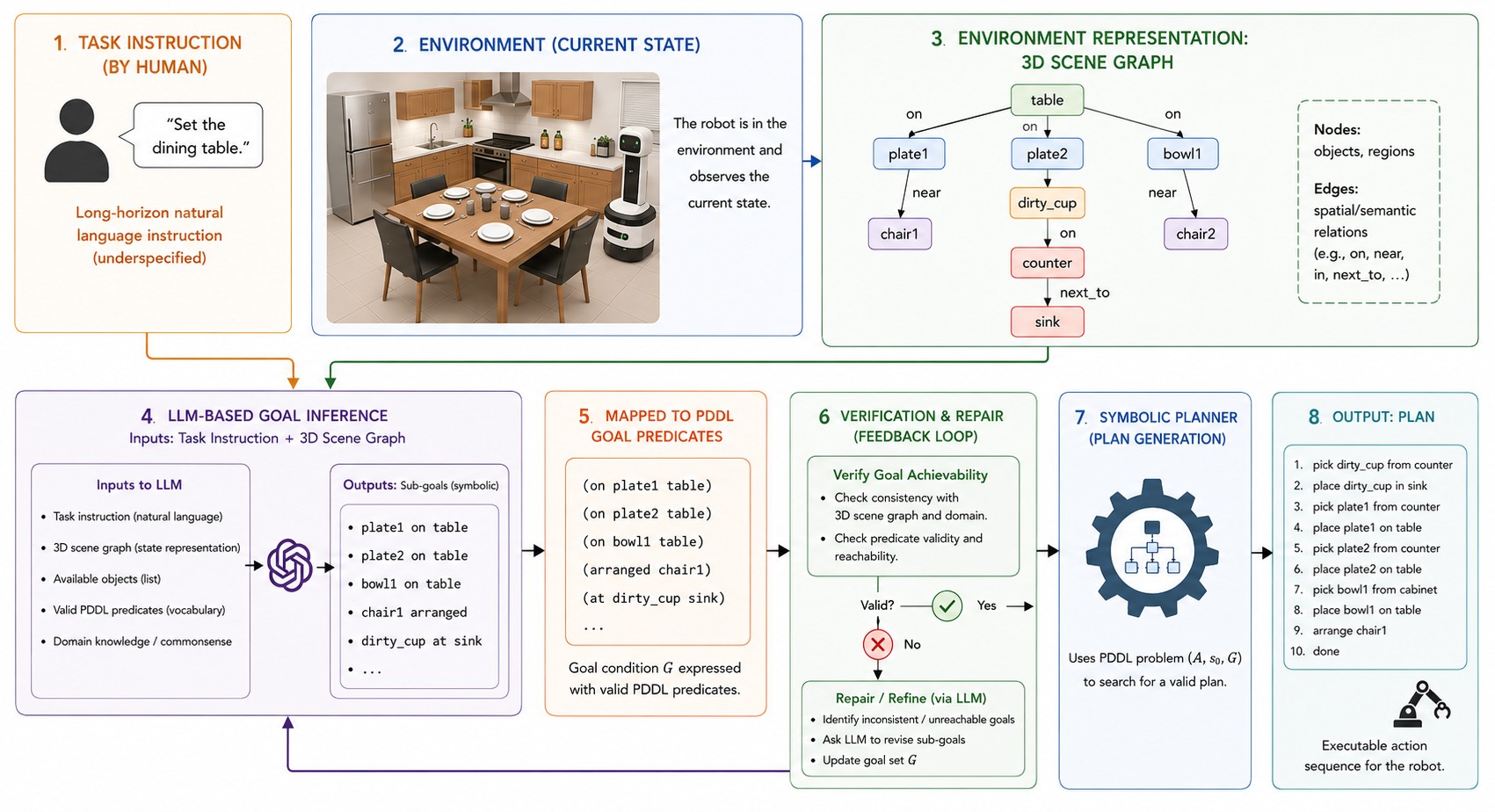
Instructions like “set the dining table” name an activity but never state the goal. Given the
scene as a 3D scene graph, an LLM infers grounded PDDL goal predicates, which are checked against
the planning domain and repaired through a feedback loop before a symbolic planner produces the
plan. The LLM supplies the common sense; the planner keeps the plan correct. Evaluation is planned
in a simulated kitchen–dining domain with BEHAVIOR-1K tasks, followed by a real-robot demo.
Interactive web game
The classic Nepali strategy board game, playable in the browser in single-player or local
multiplayer. In single-player you can face a built-in minimax engine, an LLM opponent, or an
AlphaGo-inspired neural network I trained on Bagh Chal self-play.
Learned cost estimators inside Fast Downward
C++ · PyBind · PyTorch
A system that injects learned anticipatory cost models into the Fast Downward planning stack,
letting neural cost estimation compose with standard symbolic heuristics such as FF, max, and
goal-count without modifying the planner's objective.
Navigation among movable obstacles with PDDLStream
PDDL · PDDLStream
In a 2D navigation setting, I formulated the domain in PDDL and used PDDLStream to plan obstacle
relocations that open a feasible path to the goal — a compact testbed for how local relocation
choices gradually block or preserve access.
PPO vs. DQN on Lunar Lander
Reinforcement learning
A controlled comparison of Proximal Policy Optimization and Deep Q-Networks on the Lunar Lander
benchmark, looking at learning stability, sample efficiency, and final control performance.